
When an Edible Formula Changes, Which Packaging Decisions Need Review?
Updated:
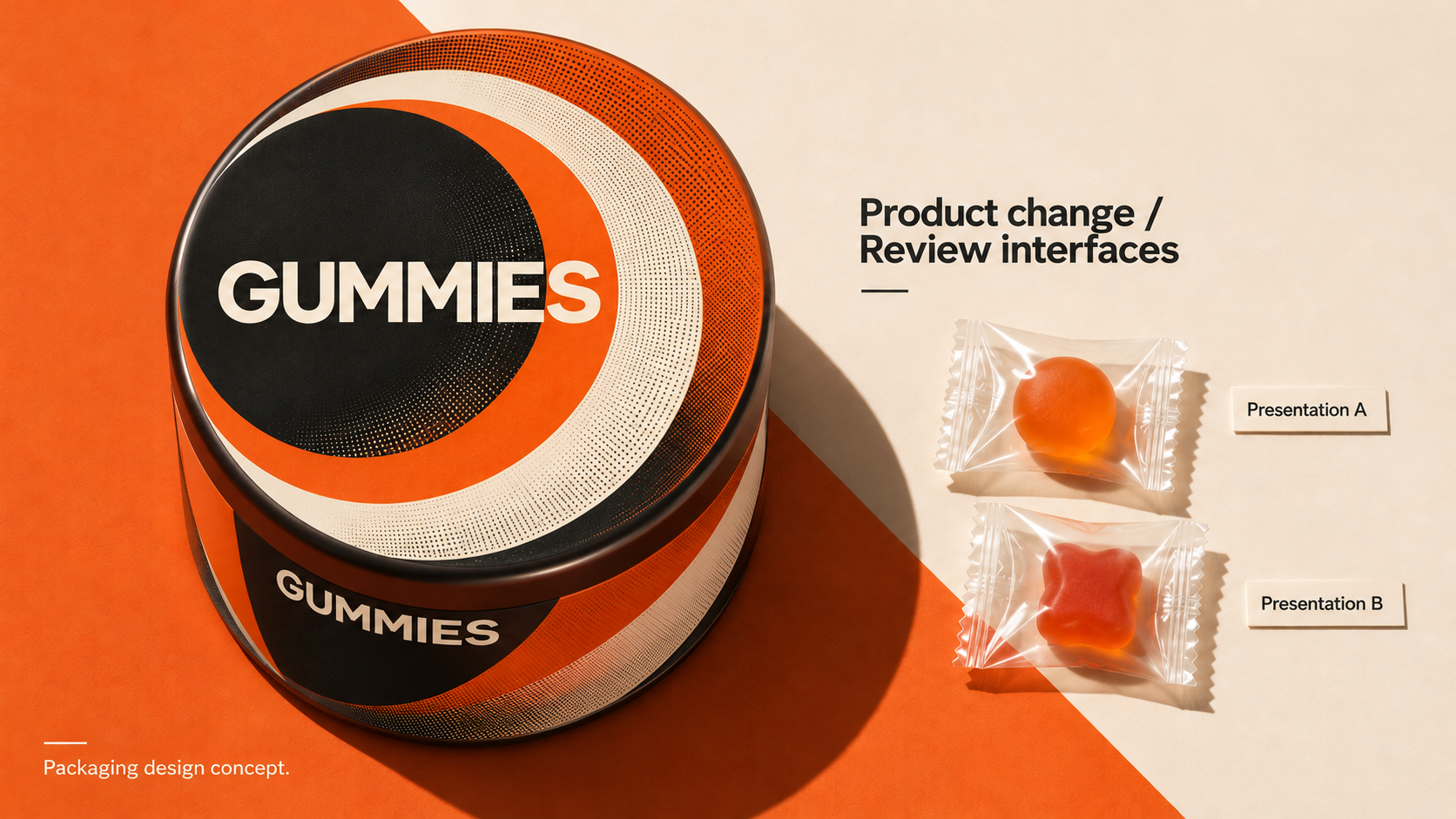

An edible's nominal dimensions stay the same after a recipe update, so one team calls the packaging unchanged while another asks to repeat every approval. Neither conclusion follows from the size alone. Trace which earlier decisions depended on the changed product information.
Use an affected-assumptions review
If the product owner reports only a content-text correction, route that question to the relevant owner without inventing a physical change. If the actual presentation, wrapping or interface changes, identify those differences for the responsible reviewers. This can keep a review focused while avoiding unsupported carry-forward. It does not predict a material reaction or prescribe a stability test.
Change-to-decision map
Use this worksheet to structure a project-specific decision. It is not a test standard or acceptance limit.
| Reported change | Question | Next review |
|---|---|---|
| Text or product-information revision | Which approved wording changes? | Content owner |
| Packed presentation change | Which layout assumptions differ? | Configuration owner |
| Changed product-interface information | Which prior evidence questions are affected? | Responsible technical reviewer |
Compare the physical presentation first
Describe the changed product as it will be packed: form, surface condition, wrapping and intended arrangement. If these are unchanged, record that as information supplied by the product owner rather than a conclusion inferred from the product name. If they differ, identify which fit or handling decisions used the previous presentation. This gives the review a focused starting point.
Trace the interfaces
Map where the product could meet the inner pack, liner, divider or tin during packing and use. A formula change may lead the responsible reviewer to ask different compatibility questions even when the external dimensions are unchanged. This article does not predict a reaction or prescribe a test. It explains why the old package name alone is insufficient evidence for the revised product.
Separate graphics from configuration
The formula update may also trigger new artwork or variable information. Manage those as linked but distinct changes. A new label does not prove the physical package remains suitable, and a fit sample does not approve the revised information. Identify the owners of each decision so one approval email does not accidentally stand in for several different reviews.
| Decision | Record |
|---|---|
| Product change | Actual presentation and wrapping |
| Interfaces | Components contacting or surrounding product |
| Carry-forward | Decision owner rationale and reference |
Define a reasoned review scope
Ask each responsible reviewer to state what can be carried forward and what needs new information. Record the rationale and the referenced versions. The objective is not automatically to repeat every historical activity; it is to avoid silently carrying forward an assumption that no longer applies. Keep unresolved points visible before purchasing commits to the revised configuration.
Use a change map to avoid blanket reapproval
A hypothetical update changes the surface finish of an edible but retains its nominal dimensions. The product owner should explain the change and the packaging reviewer should identify which interfaces merit attention. Do not assume either that everything must be retested or that nothing has changed. Record the questions raised, the evidence being carried forward and the person responsible for resolving each open item. Where the product information is incomplete, make that specific limitation visible in the purchasing record. This is more useful than a general instruction that the existing packaging is still approved.
Turn the review into a purchasing brief
Provide the product owner’s change description and a map of affected packaging interfaces. Ask the responsible reviewers to document what can be carried forward and what requires new information.
Does any formula change require a new tin?
Not automatically. Determine which existing decisions are affected.
Can an unchanged outer size settle compatibility?
No. Geometry and material compatibility are different questions.