
The First Pre-Roll Comes Out—Why Are the Rest Harder to Reach?
Updated:
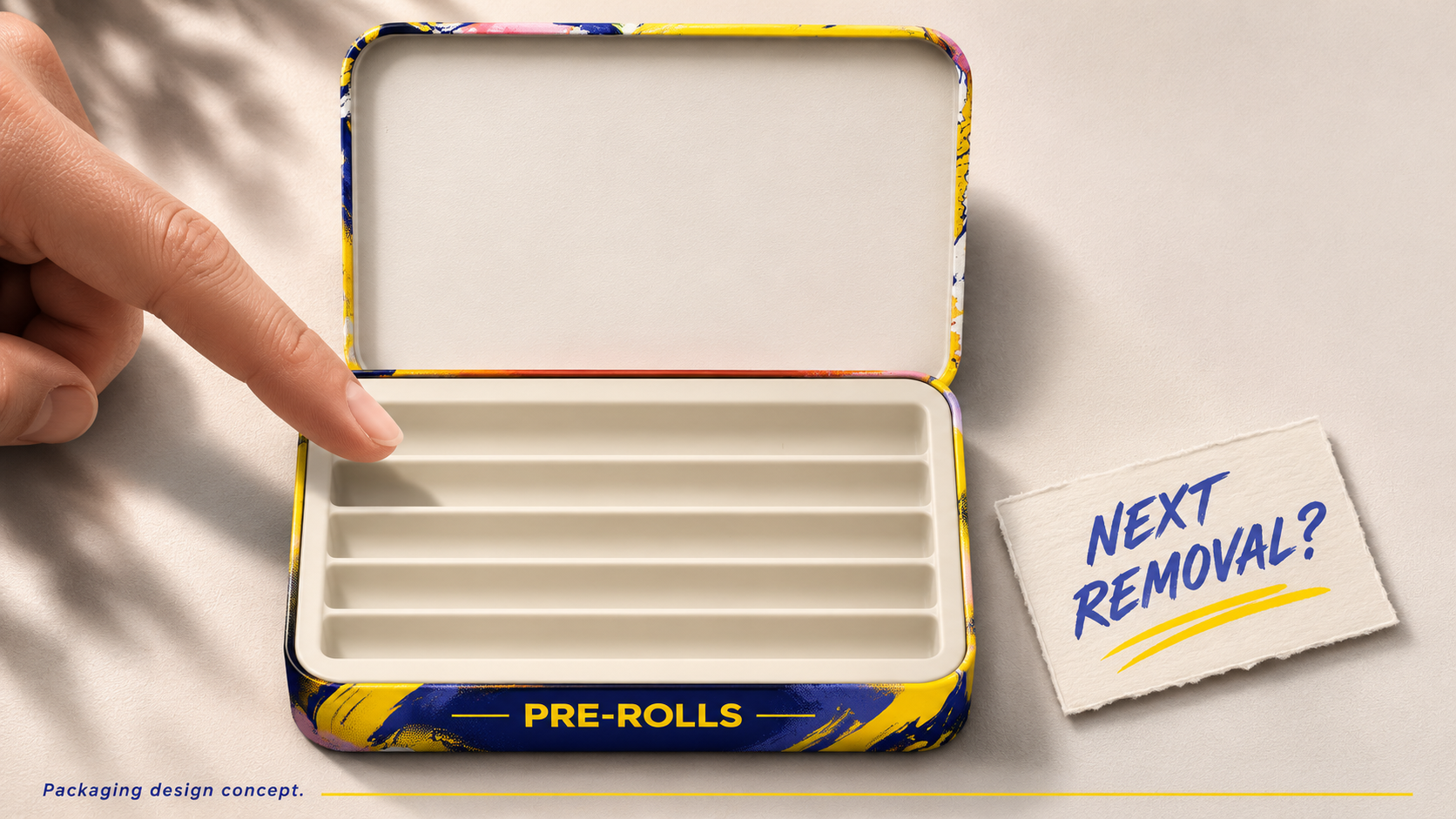

A full pack can present well while leaving a different problem after the first product is removed. Before requesting a tighter insert or another tin, distinguish three observations: remaining products change position, the intended grasp point becomes unavailable, or the user must follow an unexpected removal sequence. These lead to different proposals.
Compare use states, not just the opening photograph
Identify the pre-roll version, count, wrapping and insert used in the review. Begin with the intended full arrangement and record which item is removed. Then look at the next intended action. If the design has no prescribed order, identify which selections expose the concern rather than declaring one convenient sequence representative of all use.
This is an exploratory use review, not a standardised test. The responsible team must choose appropriate conditions; this article supplies no cycle count or acceptance threshold.
Separate location from access
If a remaining item moves away from its proposed position, the next question concerns how the arrangement locates the contents. If the item stays positioned but cannot readily be grasped, additional restraint may leave the access task unresolved. If an insert or cover must be lifted first, decide whether that sequence belongs in the intended experience.
Keep the product surface and wrapper in the discussion. A substitute object may show the layout while failing to represent the intended grasp region. State those limitations before interpreting the demonstration.
Compare three routes against the failed action
The table does not rank the routes or promise a performance improvement. Compare complete proposals, including their actual packing and component scope.
| Candidate | What it is intended to address | Trade-off to examine |
|---|---|---|
| Defined individual locations | Keep each remaining item associated with a location | Access must remain practical at each relevant use state |
| A shared arrangement | Allow contents to occupy a common space | Position and next-item selection may change during use |
| A different removal sequence | Retain some layout features while changing access | Users must understand and accept the additional action |
Make the example change the decision
In a hypothetical pack, the first item is easy to grasp while the next sits below the intended access point. The observation supports an access review for that state. It does not establish that the entire container is too small or that every pre-roll needs stronger retention.
Ask the next sample to represent the state that exposed the difficulty. If a revised arrangement helps the partly empty state but obstructs initial loading, keep both observations visible. The useful decision is which compromise meets the intended product experience, not which sample looks neatest when full.
Prepare a focused revision request
Send the configuration reference, a short removal sequence and an identified full-versus-partly-empty record. Explain which action fails and what the user should be able to do instead. Keep fit and use observations separate from protection, material and child-resistance evidence.
Should remaining products stay exactly where they started?
Only if that is an actual project requirement. Decide whether location supports access, presentation or identification before making it an acceptance condition.
Can the pack count change to improve access?
That changes the sellable offer. Evaluate it as a separate brand decision, rather than allowing an unrecorded reduction to become a sample fix.