How to Check Child-Resistant Pre-Roll Tins After Labeling
Updated:
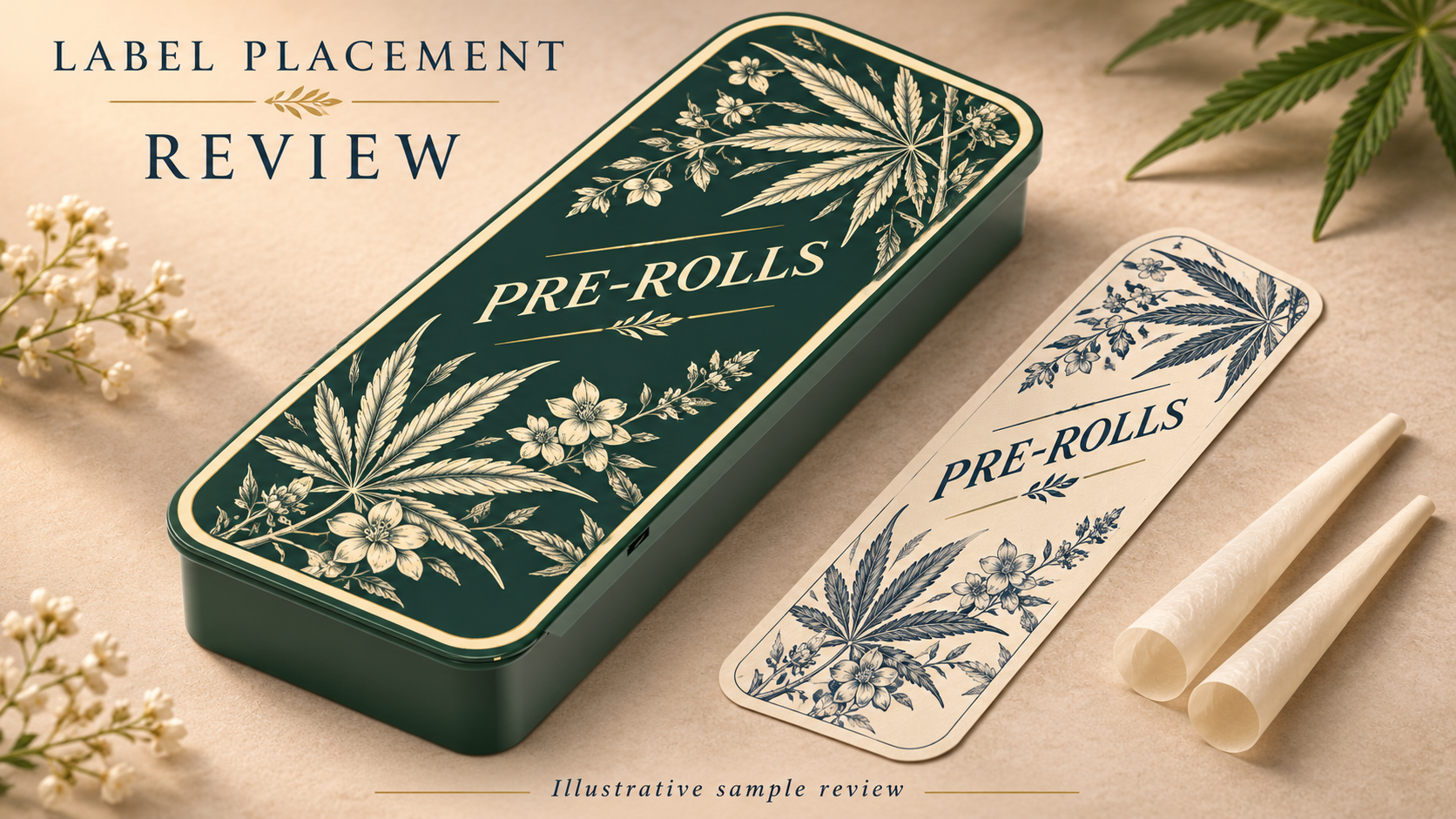
A bare tin can help explain an opening mechanism, but it cannot show whether the final label hides a cue, occupies a grip area or crosses an opening interface. Before approving a labeled pre-roll tin, compare identified bare and finished samples with the same closure, insert and representative contents. Review opening cues, grip, product retrieval and reclosing separately. If the assemblies differ, record that limitation before attributing difficulty to labeling.
A consumer in a Florida cannabis community described struggling with a pre-roll tin that required operating two buttons and pulling the pack open. That specific account raises a useful question for brands: can the intended user identify, hold and complete the opening sequence on the finished package? It does not establish a defect, a market-wide accessibility finding or the compliance status of the unidentified tin.
Identify the samples before comparing the opening action
The reported difficulty concerned coordinating more than one action. That is more specific than saying all tins are hard to open. A brand review should distinguish finding the controls, stabilising the body, operating the controls in the intended sequence and moving the opening component.
Ask for the actual configuration and its authorised instructions. Do not infer operating force or a particular engineering cause from the forum account. If the package or instructions cannot be identified, keep the comparison provisional. A familiar demonstrator opening one sample does not settle how another reviewer experiences the same intended task.
The discussion also contains differing views about adult convenience and child safety. It supplies no basis for bypassing the intended closure or weakening a safety requirement. This article does not adopt forced-opening suggestions from comments.
Record where the intended sequence becomes difficult
Use the finished sample and the conditions relevant to the project. Record what the reviewer attempts and what remains unclear before recommending a change. If guidance is provided during the demonstration, identify when it was provided; an assisted demonstration and an initial attempt are different observations.
The purpose is to choose the next review question, not diagnose a population-wide limitation or certify the closure. Have the responsible team determine appropriate review conditions. No operating-force limit, participant count or pass rate is prescribed here.
| Observed stage | Question to investigate | Potential next review |
|---|---|---|
| Finding the action | Are the intended controls and instructions identifiable? | Instruction location and presentation |
| Holding the body | What stabilising grip is intended? | Actual sample geometry and handling |
| Coordinating controls and movement | Where does the intended sequence become unclear or difficult? | A documented demonstration of that specific stage |
| Reclosing | Can the reviewer identify and follow the intended closed state? | Configuration-specific instructions and feedback |
Compare the bare tin and the labeled finished sample
Review the proposed final label, sleeve and decoration on the actual assembly. Ask whether instructions remain visible during the intended grip and whether a label crosses parts that are supposed to move. An undecorated demonstration cannot show every interaction introduced by the finished artwork.
In an Ontario pre-roll packaging discussion, one commenter described a tax sticker making a tube harder to open. Another valued a package they could open without tools. The tube comment is not evidence about a tin closure. It suggests a question to investigate on an identified tin sample; it does not establish the answer. The Florida account describes a separate opening difficulty. [Ontario pre-roll packaging discussion](https://www.reddit.com/r/TheOCS/comments/1p486b3/do_nice_preroll_tins_or_other_types_of_nicer/)
For the packaging review, compare an undecorated reference and a finished sample with the same closure, insert and representative contents. Record the label revision and placement, including the allowed placement range on the line. Observe first opening and reclosing with the intended instructions. If the problem appears only on the decorated sample, check whether the label conceals a cue, lies where the user needs to grip, or crosses an interface used during opening. Record the exact observation so artwork, production and packaging engineering can investigate the same sample. Have the responsible compliance reviewer assess any change to required labels, seals or the tested configuration before approving it.
If difficulty occurs only with the proposed decoration, compare equivalent identified assemblies before selecting a correction. A revised instruction layout, another label boundary and a structural review address different questions. A label mock-up can illustrate coverage without establishing the behaviour of final materials.
Separate opening from product retrieval and reclosing
If the pack opens but its contents are difficult to grasp, move the question to a product-access review. That is different from failing to operate the opening mechanism. Keep the product version, insert, wrapping and removal sequence identifiable so the team does not change the closure to solve an unrelated layout problem.
Then review reclosing according to the intended instructions. Record the observed feedback and any uncertainty about the closed condition. Do not convert a feeling or visual impression into proof of child resistance, airtightness or protective performance.
Send a sample request that leads to a decision
For a finished-sample review, send the tin model and component references, representative contents and wrapping, insert revision, final label artwork and placement range, intended opening instructions, and the exact stage at which difficulty was observed. Ask the supplier to identify whether the next proposal changes instructions, placement, label construction, grip geometry or contents arrangement. Retain required information and seals until the responsible reviewer approves any change. A short permissioned video can clarify the sequence. It does not substitute for sample identity or the appropriate technical evidence.
Ask the next proposal to state what it changes: instructions, decoration placement, grip-related geometry or the product arrangement. Retain the other requirements so an easier demonstration is not achieved by silently changing the product or closure scope. For a child-resistance claim, have the responsible reviewer match the applicable documents to the actual configuration; an informal handling review does not replace that assessment.
Source
[Public Florida consumer discussion](https://www.reddit.com/r/FLMedicalTrees/comments/1w6q0v7/why_is_medical_cannabis_packaging_so_difficult_to/) — individual self-report; absolute posting date unresolved.
What should I check on a labelled production sample?
Identify the actual configuration and label revision, then review instruction visibility, grip, intended opening sequence and reclosing. Keep observed difficulty and its unconfirmed cause separate.
Does a difficult demonstration prove the tin is defective or noncompliant?
No. Preserve the observation and investigate the identified configuration and task. Defect, accessibility and compliance conclusions require their own appropriate evidence.
Can clearer instructions resolve every opening problem?
No. They are a candidate response when the intended action is not understood. A physical interaction or another unresolved handling task needs its own review; the supplier should not promise a universal fix.