
The Vape Fits on Paper but Not in the Insert: What Was Missed?
Updated:
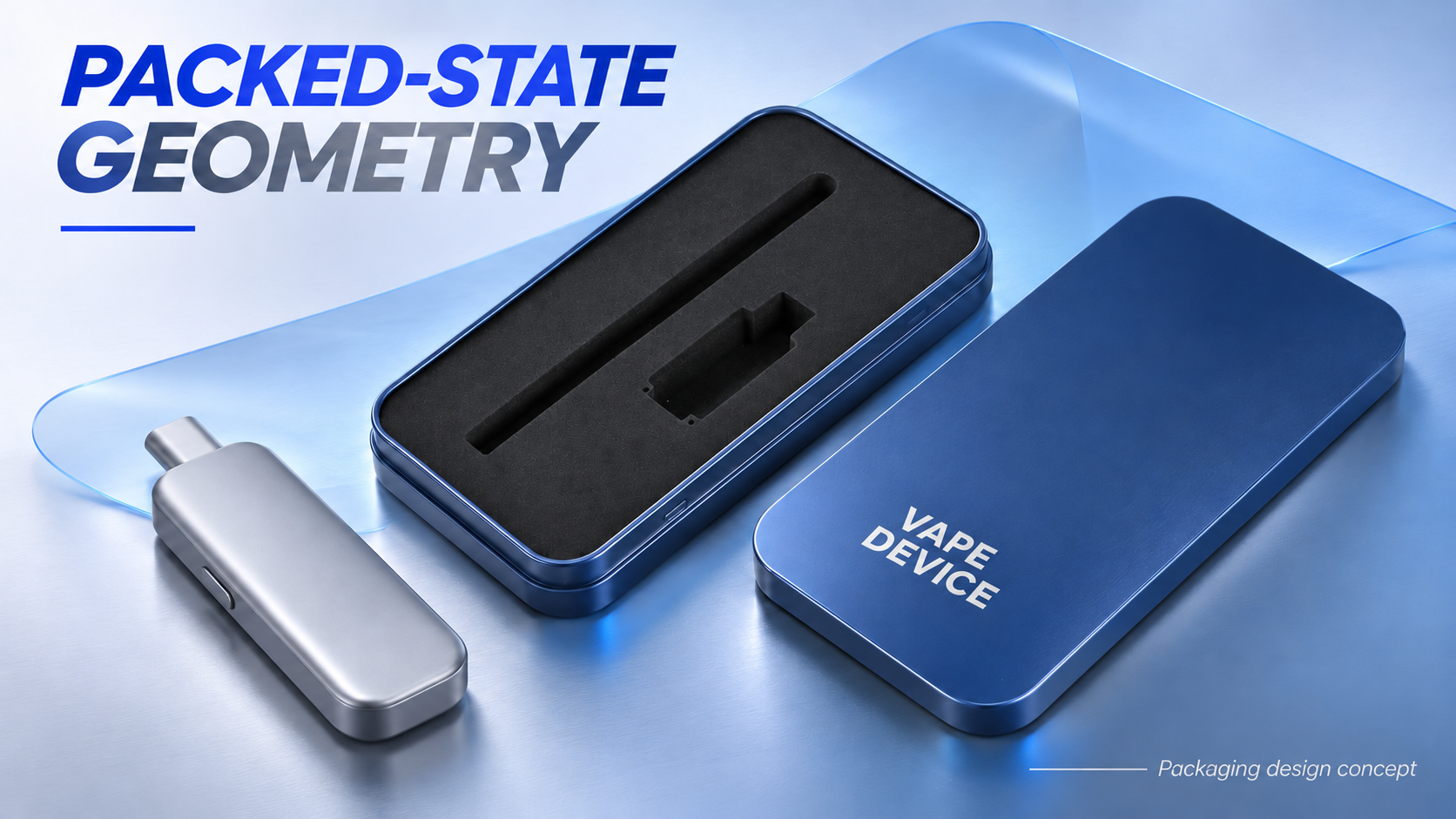

When a proposed insert accepts the outline on a drawing but not the intended device, first compare the packed product with the drawing input. A missing cover, projecting control or changed accessory state can make the original comparison incomplete. Another possibility is that the device enters its location but cannot follow the intended loading or removal path. Distinguish those questions before selecting a larger tin.
Establish which product the drawing represents
Record the device revision and intended packed state. Identify whether a cartridge is attached, a protective cover remains fitted or a sleeve surrounds the device. The product owner should identify any restricted contact regions and the reason for those restrictions.
A marketing length and width do not locate individual features. Request the views needed to show relevant protrusions and proposed supports. Do not infer dimensions or clearance from a product photograph.
Distinguish an envelope mismatch from a path problem
An envelope mismatch means the reviewed product state differs from the one represented in the proposal. A path question concerns how the actual device reaches or leaves its intended position. A sample resting inside a location does not describe every movement needed to put it there.
Do not force the device through an obstruction to obtain a successful photograph. Preserve the observation and ask the responsible team which comparison should follow.
| Observation | First uncertainty to resolve | Candidate next review |
|---|---|---|
| A cover is present on the product but absent from the input | Whether the proposed geometry describes the sellable device | Update packed-state information before judging the proposal |
| The outline appears to fit but loading catches a feature | Whether the loading path was represented | Compare an appropriate orientation or arrangement proposal |
| One device variant fits and another does not | Whether the shared layout represents both variants | Identify the exception and compare variant-specific configurations |
| The product enters but is difficult to retrieve | Whether the layout provides intended access | Continue with a removal review rather than a capacity claim |
Compare a geometry correction with a structure change
Correcting the input may allow the supplier to reassess the existing candidate. A different internal arrangement may preserve the outer presentation while changing support or access. Another container may be appropriate when the agreed product and use requirements cannot be accommodated in the proposal.
These routes affect different work: drawings, insert development, artwork or secondary packing. Obtain the actual scope of each proposal instead of assuming the smallest-looking change is cheapest or quickest.
Use a representative sample deliberately
Suppose a hypothetical development model lacks the final protective cap. It may support a discussion about part of the layout, but it leaves the capped state unresolved. Record that limitation before the sample is approved for a broader purpose.
For the next review, provide the intended product or identify how its substitute differs. Ask which placement, support and retrieval decisions the comparison will answer. Material compatibility and protective performance require separate evidence; this geometry discussion does not establish them.
Send the failed combination, not just the nominal size
Supply the product revision, packed-state views, insert reference and a marked record of the point where placement differs from expectation. Those inputs make the next question specific enough to investigate.
Is a new tin necessary whenever a feature was missed?
No conclusion follows automatically. Reassess the actual geometry and candidate arrangements before choosing which part of the proposal must change.
Can the longest device represent the full range?
Not necessarily. Compare relevant feature locations and packed states; a shorter device may introduce another support or access question.